
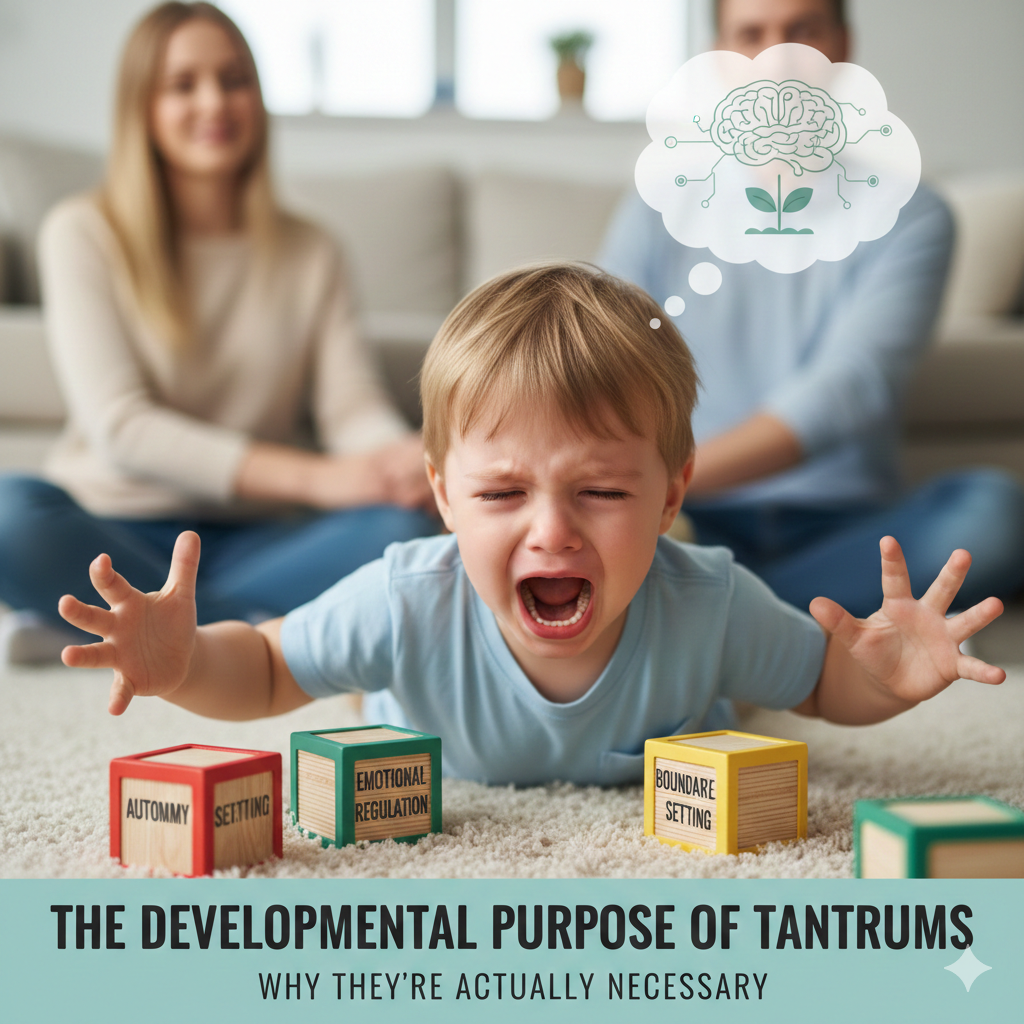
If you’re parenting a toddler, tantrums can feel overwhelming, embarrassing, and exhausting. One minute your child is laughing, and the next they’re on the floor crying because the banana broke in half or you gave them the “wrong” color cup.
Many parents worry:
“Is this normal?”
“Am I doing something wrong?”
“Why does my toddler have so many tantrums?”
Here’s the reassuring truth: tantrums are not a sign of bad behavior or poor parenting. They are a normal, healthy, and necessary part of toddler development.
In this article, we’ll explore why tantrums happen, what purpose they serve in brain development, and how parents can respond in ways that actually help toddlers grow emotionally.
What Is a Tantrum?
A tantrum is an emotional outburst that may include crying, screaming, kicking, hitting, throwing objects, or collapsing on the floor. Tantrums typically begin around 12–18 months, peak between ages 2 and 3, and gradually decrease as children develop better communication and self-regulation skills.
Tantrums are not manipulation. Toddlers are not trying to control adults. They are simply responding to emotions that feel too big for their developing brains to handle.
The Toddler Brain: Why Tantrums Are Inevitable
To understand tantrums, we need to look at brain development.
The Emotional Brain Is in Charge
Toddlers rely heavily on the amygdala, the part of the brain responsible for emotions like fear, frustration, and anger. When a toddler is upset, this emotional center takes over.
The Logical Brain Is Still Under Construction
The prefrontal cortex, which helps with reasoning, impulse control, and emotional regulation, is very immature in toddlers. This part of the brain won’t be fully developed until early adulthood.
That means toddlers:
- Cannot calm themselves easily
- Cannot think logically when upset
- Cannot express complex emotions with words
So when emotions overwhelm them, their bodies respond with a tantrum.
Tantrums are a brain-based reaction, not a behavioral choice.
The Developmental Purpose of Tantrums
Tantrums may look chaotic, but they serve several important developmental functions.
1. Tantrums Help Toddlers Release Overwhelming Emotions
Toddlers experience intense emotions but lack the skills to manage them. Tantrums act as a pressure release valve.
Imagine feeling frustrated, tired, hungry, or disappointed—but not having the words or coping tools to explain it. Crying and screaming become the only way to release that emotional overload.
Without tantrums, emotions would build up inside toddlers with nowhere to go.
2. Tantrums Are Part of Emotional Learning
Every tantrum is a learning experience.
Through repeated emotional experiences, toddlers slowly learn:
- What emotions feel like
- That emotions rise and fall
- That they can survive big feelings
With supportive adults, toddlers begin to understand that feelings are temporary and manageable.
This process is essential for developing emotional intelligence later in life.
3. Tantrums Support Independence and Autonomy
Toddlers are in a stage where they desperately want control and independence:
- Choosing their clothes
- Feeding themselves
- Deciding what happens next
When they can’t do what they want, frustration often leads to tantrums.
These emotional reactions are part of a toddler’s growing sense of self. They are learning:
- “I have preferences.”
- “I can want things.”
- “I am separate from my caregiver.”
Tantrums are often the emotional side effect of healthy independence.
4. Tantrums Help Develop Communication Skills
Before toddlers can say:
- “I’m frustrated”
- “I’m overwhelmed”
- “I need help”
They communicate through behavior.
Tantrums are an early form of communication. Over time, with patient guidance, toddlers learn to replace tantrums with words.
This transition happens naturally as language skills grow—not through punishment, but through modeling and support.
5. Tantrums Strengthen the Parent-Child Bond (When Handled Well)
How adults respond during tantrums shapes a child’s emotional development.
When parents:
- Stay calm
- Offer comfort
- Set gentle boundaries
Toddlers learn that:
- Their emotions are safe
- Adults can help them through hard moments
- Relationships remain secure even during distress
This builds secure attachment, which is crucial for mental health, confidence, and resilience.
Common Triggers for Toddler Tantrums
Understanding triggers can help parents respond with empathy.
Biological Triggers
- Hunger
- Fatigue
- Overstimulation
- Illness
Developmental Triggers
- Limited language skills
- Desire for independence
- Difficulty waiting
- Trouble transitioning between activities
Environmental Triggers
- Loud or crowded spaces
- Changes in routine
- Too many choices
- Unrealistic expectations
Often, tantrums are a combination of several triggers at once.
What Tantrums Are NOT
Let’s clear up some common myths.
❌ Tantrums are not manipulation
❌ Tantrums are not signs of spoiled behavior
❌ Tantrums are not attention-seeking in a negative way
❌ Tantrums are not caused by “bad parenting”
Tantrums are a developmental stage, just like crawling or teething.
How Parents Can Support Healthy Emotional Development During Tantrums
The goal isn’t to stop tantrums completely—it’s to guide toddlers through them.
1. Stay Calm (Even When It’s Hard)
Your calm nervous system helps regulate your child’s overwhelmed one.
If you react with yelling or punishment, the toddler’s emotional brain becomes even more activated.
Calm responses teach emotional safety.
2. Name the Emotion
Simple phrases help toddlers connect feelings to words:
- “You’re feeling frustrated.”
- “You’re really upset.”
- “That was disappointing.”
This builds emotional vocabulary over time.
3. Set Gentle, Clear Boundaries
Empathy does not mean permissiveness.
You can say:
- “I won’t let you hit.”
- “It’s okay to be angry, but not okay to throw toys.”
Boundaries help toddlers feel safe and supported.
4. Offer Comfort, Not Lectures
During a tantrum, toddlers cannot process logic.
Focus on:
- Presence
- Reassurance
- Physical comfort (if welcomed)
Teaching happens after the storm passes.
5. Help After the Tantrum Ends
Once calm returns:
- Talk briefly about what happened
- Model coping strategies
- Encourage simple problem-solving
This is when learning truly occurs.
When Are Tantrums a Concern?
Most tantrums are normal. However, consider consulting a pediatrician or child specialist if:
- Tantrums are extremely frequent or intense
- They continue well beyond age 5
- Your child consistently hurts themselves or others
- There are concerns about speech, hearing, or development
In most cases, tantrums lessen naturally as emotional and language skills grow.
The Bigger Picture: Tantrums Build Stronger Adults
Toddlers who are allowed to:
- Feel emotions
- Express frustration
- Receive empathy and guidance
Grow into children and adults who:
- Regulate emotions better
- Communicate more effectively
- Handle stress more resiliently
Tantrums are not obstacles to development—they are stepping stones.
Final Thoughts
Tantrums may feel disruptive, but they are a sign that your toddler’s brain is growing, learning, and adapting.
Instead of asking:
“How do I stop tantrums?”
Try asking:
“How can I help my child learn through them?”
With patience, empathy, and consistent support, tantrums become powerful moments of emotional growth—for both toddlers and parents.
Leave a Reply